
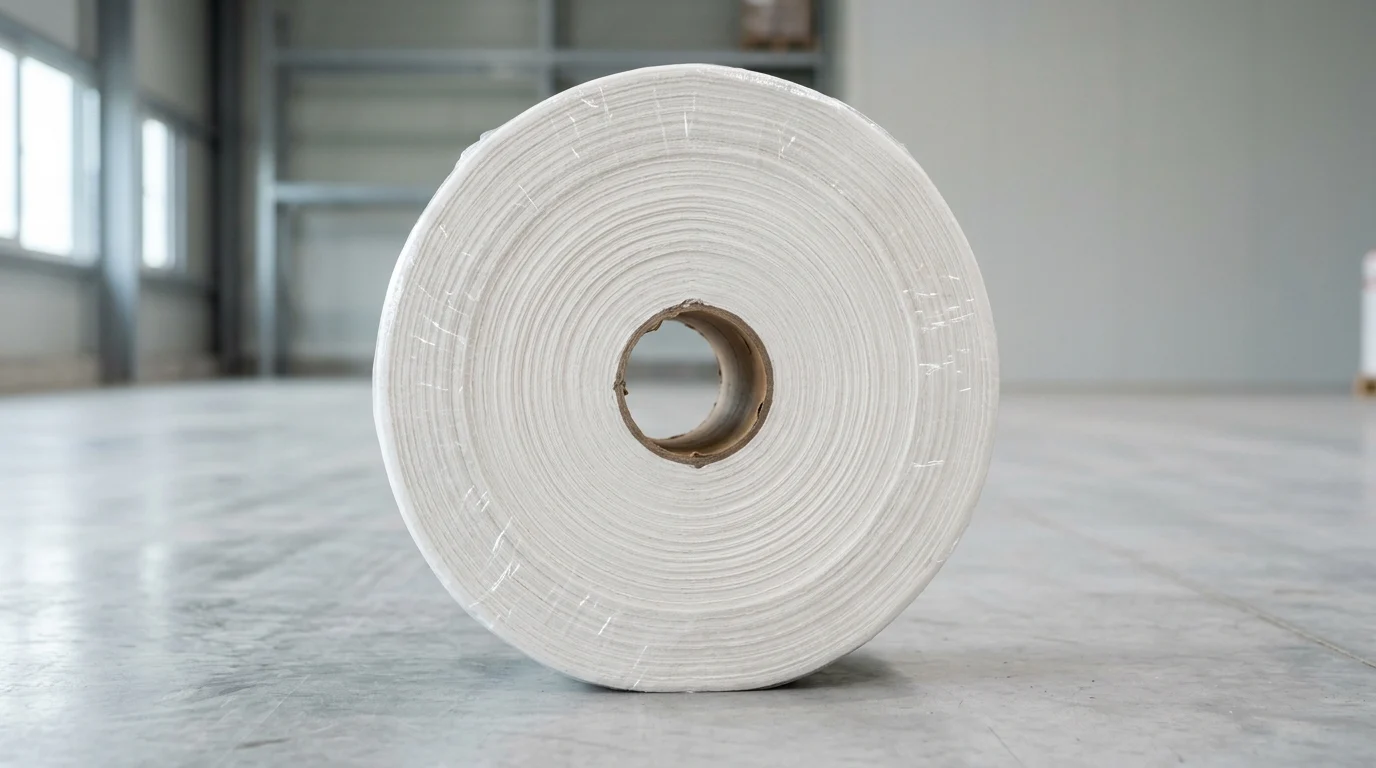
Why Tissue Jumbo Roll Consumption Matters in Factory Costing
Factory managers know that raw material costs—often representing 65% to 75% of total production expenses—make or break profit margins in the tissue converting industry. When evaluating production expenses, tracking tissue jumbo roll consumption is usually the biggest piece of the puzzle. Because these materials are processed at incredibly high speeds (often exceeding 400 to 600 meters per minute), even a 0.5% drop in efficiency can compound into significant cost overruns over a fiscal quarter. Understanding exactly how much paper goes into the machine versus what comes out as a finished, sellable product is essential for accurate factory costing and keeping operations highly profitable. To do this effectively, analysts must distinguish between three key metrics: consumption ratio (the raw material input required to produce one unit of output), yield (the percentage of raw material that successfully becomes finished product), and waste rate (the percentage of material lost during converting).
What Counts as a Tissue Jumbo Roll
A standard tissue jumbo roll—often referred to as a mother roll or parent roll—is the massive, unconverted spool of soft tissue used as the foundational raw material for finished hygiene products. These rolls typically range from 1,100 mm to 2,500 mm in diameter and 1,200 mm to 3,600 mm in width, with total weights spanning 300 kg to 1,200 kg per roll. They are built specifically for industrial lines that slit, fold, emboss, perforate, and package the paper into consumer goods. They typically feature standard 76 mm (3-inch) or 152 mm (6-inch) inner cores to seamlessly fit automated converting equipment, though custom core sizes are readily available for specialized setups. Because the roll is supplied in extremely large diameters and widths, manufacturers can achieve longer continuous production runs, drastically reducing changeover time and keeping converting costs in check.
Key Cost Factors to Compare
Raw material yield directly impacts the bottom line, and several key cost factors dictate how efficiently a roll performs on the factory floor. Buyers need to evaluate the pulp type alongside the ply count, which usually ranges from 1-ply to 5-ply structures depending on the required softness and absorbency. Another major cost driver is the grammage or basis weight, which generally sits between 12 and 42 GSM (grams per square meter).
The table below outlines typical performance and cost bands across common pulp types:
| Pulp Type | Typical GSM Range | Relative Cost Index | Typical Yield Rate | Primary Application |
|---|---|---|---|---|
| Virgin Wood | 12 – 18 GSM | High (1.00) | 95% – 97% | Premium Facial & Toilet Tissue |
| Bamboo | 15 – 20 GSM | Medium (0.85) | 94% – 96% | Eco-Friendly / Unbleached Tissue |
| Recycled Mixed | 18 – 42 GSM | Low (0.70) | 92% – 95% | Commercial & Kitchen Towels |
Thicker, heavier paper, like a 40 GSM kitchen towel base, costs more per square meter but might run with fewer web breaks on the machine, effectively lowering the hidden costs of mechanical downtime and material waste compared to a delicate 13 GSM facial tissue base.
How to Calculate Tissue Jumbo Roll Consumption and Yield
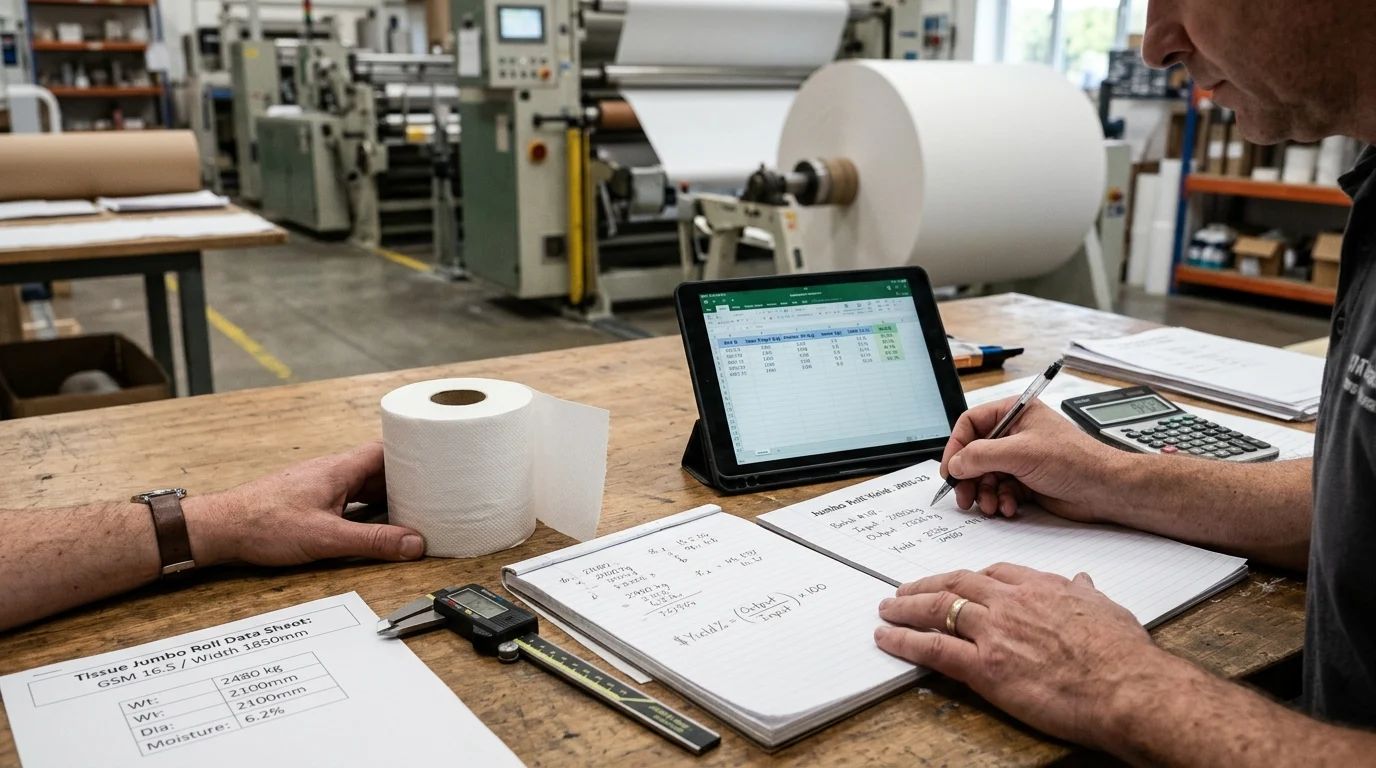
Figuring out the exact yield of a raw material, such as a standard facial tissue parent roll, requires looking closely at the converting-line material balance. A practical measurement protocol bridges the gap between theory and the shop floor: operators should tare unwinder stands to weigh the net raw material, weigh finished pallets minus the packaging tare, and sample moisture with a handheld meter (industry standard targets are typically 4% to 7% moisture content). Converters need to track the theoretical output against the actual physical output to pinpoint the true consumption rate. This requires factoring in technical caveats like moisture content variation between raw and finished goods, the exclusion of packaging weights from the final product, and proper core weight handling, all of which can materially distort factory costing by 1% to 3% if ignored.
Core Formulas for Weight, GSM, and Output
The core formula for calculating the theoretical weight of a roll relies on its physical dimensions and basis weight. The standard calculation is: Roll Width (meters) × Roll Length (meters) × GSM (grams per square meter) = Total Weight in grams. For example, a 2.8-meter wide roll that is 3,000 meters long with a basis weight of 15 GSM has a theoretical weight of 126,000 grams, or 126 kg.
To formalize the converting metrics, factories rely on three primary equations:
- Consumption Ratio =
Input Weight / Output Weight - Yield % =
(Finished Weight / Raw Weight) × 100 - Waste % =
[(Raw Weight − Finished Weight) / Raw Weight] × 100
To apply these accurately when raw and finished goods have different moisture levels, analysts should convert weighed masses to bone-dry weights. For example, if a 1,000 kg raw roll has 6% moisture, its bone-dry weight is 940 kg. If the finished goods weigh 950 kg at 4% moisture, the bone-dry finished weight is 912 kg. Using these bone-dry figures in the formulas prevents moisture variations from skewing the yield.
Consider a step-by-step material balance: A production run uses 1,050 kg of raw tissue input (after explicitly excluding the heavy cardboard core weight). During the run, the line generates normal edge trim, splice loss, and unusable bottom-of-the-roll paper. After removing all packaging weight from the final pallets, the line yields exactly 1,000 kg of actual retail toilet paper. The consumption ratio is 1.05 (1,050 kg input / 1,000 kg output). Using the formal waste equation [(1,050 - 1,000) / 1,050] × 100, the true waste rate against the raw input is approximately 4.76%.
How to Separate Normal Waste from Avoidable Loss
When analyzing that 4.76% loss, it is vital to remember that not all waste is created equal.
How to Use Yield Data to Improve Converting Performance
Tracking the yield of a tissue jumbo roll goes beyond simple cost accounting; it serves as a practical roadmap for optimizing your entire converting line. When facility managers know exactly how much finished toilet paper or facial tissue comes out of their raw materials, they can easily spot mechanical inefficiencies or material defects before they eat into profit margins.
Supplier and Machine Data to Check
To get a clear picture of converting performance, start by aligning your machine logs with the technical specifications provided by your supplier. A tissue jumbo roll might look perfect on the warehouse floor, but minor inconsistencies can cause major headaches during high-speed folding, embossing, or perforating. Always monitor the following data points:
- GSM and Moisture Levels: Fluctuations in basis weight (typically 12–42 gsm) or moisture content lead to uneven web tension and frequent machine breaks.
- Tensile Strength: Inadequate wet or dry strength forces operators to slow down production runs to prevent tearing.
- Dimensional Accuracy: Ensure the roll width and the standard 76 mm (3-inch) core perfectly match your unwinding equipment to minimize edge trim waste and prevent alignment issues.
How Consumption Records Support Better Decisions
By maintaining detailed consumption records, factory managers can turn raw numbers into actionable manufacturing strategies. If the waste rate on a specific converting line suddenly spikes, historical yield records help pinpoint the exact culprit. The data will reveal whether the machinery needs maintenance—such as sharpening dull slitting blades—or if a recent batch of tissue jumbo rolls suffered from excessive dusting and poor paper formation.
Consistent yield tracking also empowers buyers to make smarter purchasing choices. Procurement teams can use these metrics to compare different material grades, such as virgin wood pulp versus recycled pulp, to see which option delivers the best balance of high-speed runnability and minimal waste. Ultimately, hard data gives you the leverage needed to negotiate better supplier contracts and fine-tune your equipment settings for maximum output.
Key Takeaways
- Track consumption ratio, yield, and waste rate separately because each metric reveals a different part of raw material efficiency and factory cost.
- Since raw materials can represent 65% to 75% of tissue production expenses, even small yield changes can significantly affect margins.
- Use actual input weight and finished sellable output to calculate yield, then monitor waste by shift, machine, product type, and roll batch.
- Compare pulp type, GSM, ply count, roll width, diameter, and core size before purchasing because these specifications directly influence converting efficiency.
- Benchmark expected yield by material, with virgin wood typically at 95%–97%, bamboo at 94%–96%, and recycled mixed pulp at 92%–95%.
Frequently Asked Questions
What is tissue jumbo roll consumption in factory costing?
It is the amount of parent roll material used to produce a finished tissue output. It helps factories calculate raw material cost per carton, pack, or ton and identify where converting losses occur.
How do you calculate tissue jumbo roll yield?
Yield is calculated as finished sellable output divided by total jumbo roll input, then multiplied by 100. For example, 950 kg finished product from 1,000 kg input equals a 95% yield.
What is a normal waste rate for tissue converting?
Waste rates vary by pulp type, GSM, product design, machine condition, and packaging process. Virgin wood tissue often reaches 95%–97% yield, while recycled mixed pulp may run closer to 92%–95%.
Why does GSM affect tissue roll consumption?
Higher GSM means more paper mass per square meter, so each finished roll, sheet, or pack consumes more raw material. Accurate GSM control is essential for stable costing and margin protection.
What factors should buyers compare before ordering jumbo rolls?
Compare pulp type, GSM, ply count, roll width, diameter, core size, moisture, softness, strength, and expected yield. These factors determine machine compatibility, production efficiency, and true cost per finished unit.
Post time: Oct-26-2026