
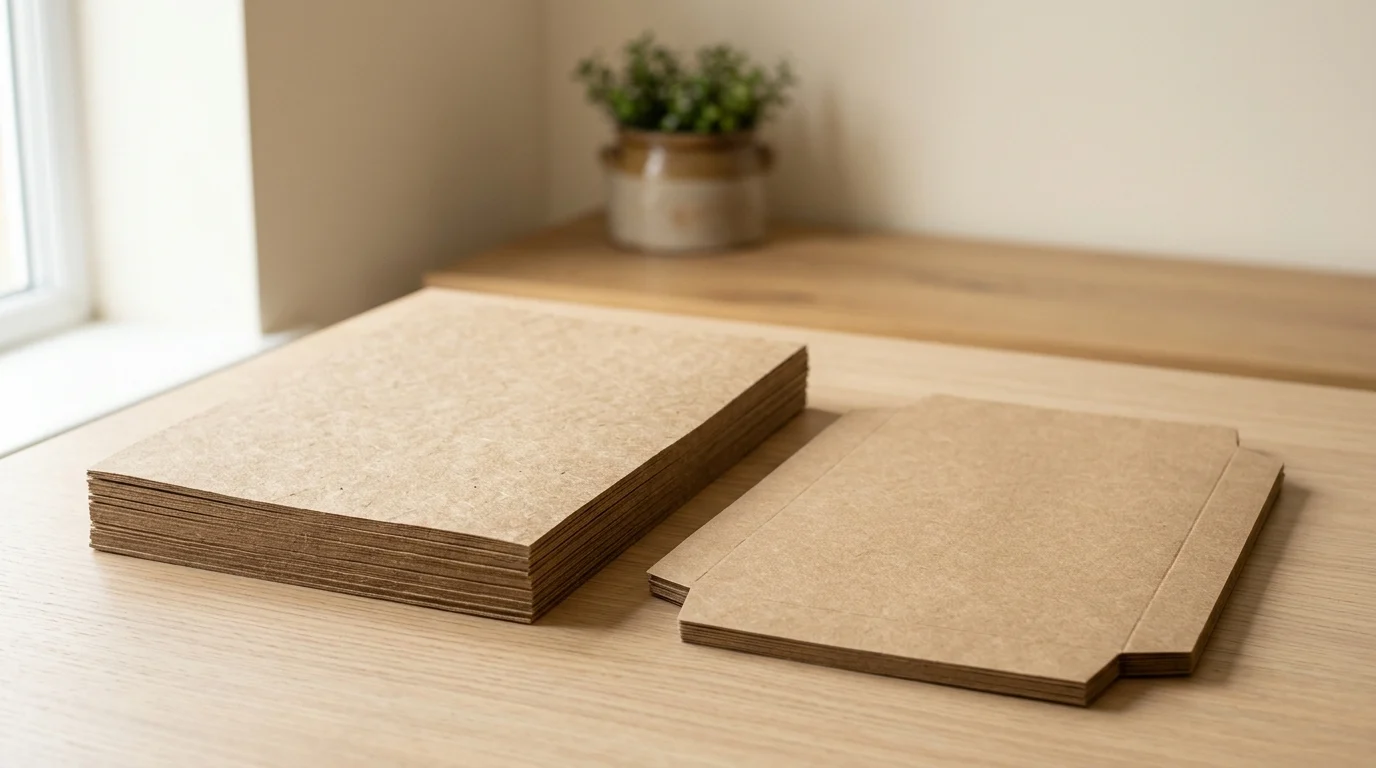
Define Kraft Paper for Envelopes
Sourcing the right kraft paper for envelope manufacturing starts with understanding the basic building blocks of the material. Made primarily from wood cellulose fibers through the kraft chemical process, this paper is naturally strong, versatile, and eco-friendly.
The material is specifically designed to handle the rigors of automated production lines while protecting documents, catalogs, and lightweight goods in transit. For B2B printing houses and logistics firms, specifying the correct foundation prevents costly machine jams and material waste.
Key converting requirements
Manufacturers need paper that behaves predictably on the production floor. Envelope converting machines often run at high speeds, processing anywhere from 500 to 1,200 envelopes per minute. At these speeds, the paper must offer excellent foldability without cracking at the seams.
Stiffness is another crucial factor; if the paper is too flimsy, it will jam the folding machinery, causing expensive downtime and high defect rates. Additionally, the surface must accept standard glues and window-patching films seamlessly, ensuring that rapid adhesive application (often cited as under 0.5 seconds) creates a permanent, secure bond.
Core specification terms
To buy the right material, buyers have to speak the language of paper mills. Grams per square meter (GSM) dictates the weight and thickness, which directly influences both durability and final shipping costs.
Machine direction (MD) and cross direction (CD) describe the alignment of the fibers, which impacts how the paper tears and folds along the envelope’s creases. Moisture content plays a massive role in converting success as well. A moisture level commonly targeted between 5% and 7% is often required, though this varies by mill and regional climate; high-humidity environments, for instance, may require adjusted moisture targets to prevent the paper from curling, shrinking, or becoming too brittle during warehouse storage and processing.
Compare Kraft Paper Specifications
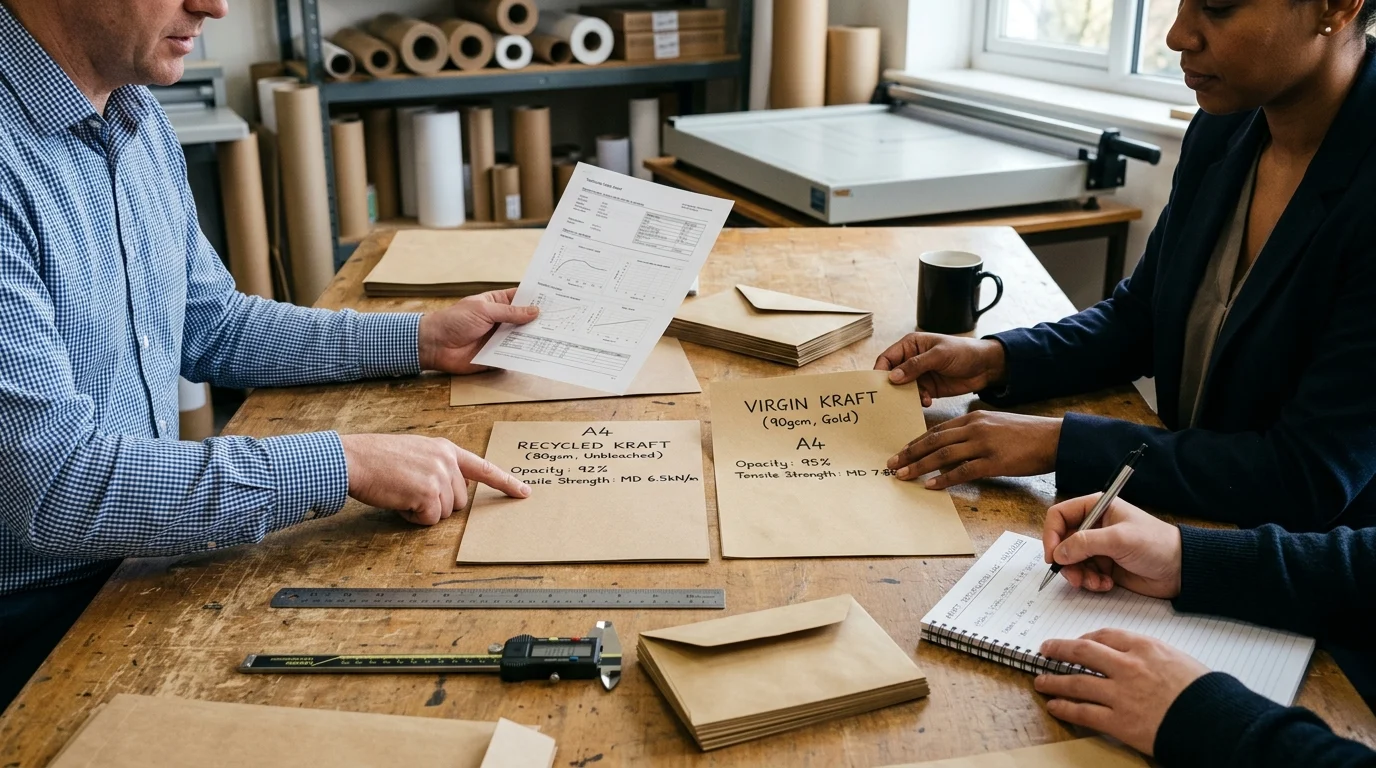
When comparing kraft paper jumbo rolls, buyers must weigh mechanical properties against aesthetic finishes.
A heavy-duty expansion mailer needs a completely different set of specs than a standard corporate window envelope, and specifying these properties prevents both product failures and unnecessary material spending.
GSM, tensile strength, tear resistance, and foldability
Different envelope styles demand specific weight classes and strength profiles. Rather than just looking at baseline definitions, buyers must evaluate how these metrics apply to their specific product. Tensile strength, which measures how much tension the paper can take before snapping, is commonly cited as needing to be greater than 5.0 kN/m in the machine direction for reliable mailing, though this depends on the testing standard used.
Tear resistance ensures that sharp corners of documents will not puncture the envelope during transit. Foldability must be matched to the envelope’s design, as stiff paper with poor fold directionality will easily crack at the gussets of expansion envelopes.
| Envelope Type | Typical GSM Range | Primary Use Case |
|---|---|---|
| Standard Business | 70 – 90 GSM | Invoices, daily office correspondence |
| Catalog Mailer | 100 – 120 GSM | Heavy documents, magazines, brochures |
| Expansion / Padded | 130 – 150+ GSM | Bulky e-commerce goods, hard drives |
Natural brown, white, and coated paper options
The visual finish of the paper also dictates its performance and environmental footprint. Natural unbleached brown kraft is highly eco-friendly and biodegradable, making it a favorite for sustainable brands looking to lower their carbon footprint.
White kraft goes through a bleaching process—where the specific chemistry used, such as Elemental Chlorine-Free (ECF) versus Totally Chlorine-Free (TCF), matters for sustainability claims—to provide a crisp, high-contrast background for colorful promotional designs. However, bleaching can reduce fiber strength by roughly 5% to 10%, meaning buyers might need to bump up the GSM slightly to match the durability of a brown envelope. Coated options are also available, adding moisture-resistant barriers or poly-linings for packages that require extra weather protection, though it is critical to note that poly-coated kraft is often non-recyclable in standard streams.
Choose the Right Kraft Paper
Selecting the perfect kraft paper comes down to testing the material in real-world scenarios and aligning those results with the company’s bottom line.
The strongest paper in the world will not help if it cannot hold ink properly, jams the offset printer, or costs too much to ship in bulk.
Printability testing steps
Before committing to a massive order, converters should implement a due-diligence checklist. Procurement teams should request mill certificates of analysis (COA), verify caliper consistency across the roll, and check for cockling at target moisture levels.
Next, converters should run printability tests for flexo or offset printing. The paper’s surface needs to be smooth enough to capture fine barcode details but textured enough to absorb ink quickly without smearing. Mills measure this using the Bendtsen smoothness scale; a reading of 200 to 400 ml/min is generally ideal for standard envelope printing. It is always a smart move to run a 5,000-piece trial batch to check ink adhesion, logo clarity, and how well the adhesives stick to the paper flaps under normal drying conditions.
Matching paper to business needs
Ultimately, the specifications have to match the end user’s operational needs. Financial institutions sending sensitive documents require high opacity (often specified at greater than 95%) and may also require a custom security tint printed on the inside. Because opacity and security tinting are separate specifications and neither alone guarantees complete confidentiality, they are frequently combined.
E-commerce brands and logistics companies prioritize lightweight durability to reduce shipping costs per unit. When sourcing these materials, procurement teams also need to factor in minimum order quantities (MOQs). Custom jumbo rolls typically require an MOQ of 3 to 5 metric tons. Aligning technical specs with storage capacity, compliance targets, and budget constraints ensures a smooth, cost-effective manufacturing run.
To guide the final decision, buyers can map their envelope types to recommended specification bundles:
● Standard Business: 70–90 GSM, moderate MD tensile target, smooth finish, suitable for high-speed offset printing.
Key Takeaways
● Match kraft paper GSM to the envelope type, using about 70–90 GSM for standard business envelopes and 100–120 GSM for many catalog mailers.
● Specify machine direction and cross direction clearly because fiber alignment directly affects folding quality, tear behavior, and seam strength.
● Control moisture content around the mill-recommended range, often 5%–7%, to reduce curling, brittleness, shrinkage, and converting waste.
● Evaluate tensile strength, tear resistance, and foldability together instead of buying only by paper weight.
● Choose paper with consistent stiffness and glue acceptance to support high-speed envelope lines running hundreds or even over 1,000 envelopes per minute.
Frequently Asked Questions
What GSM is best for kraft paper envelopes?
Standard business envelopes commonly use 70–90 GSM, while catalog mailers often need 100–120 GSM. Heavier expansion or protective mailers may require higher basis weights depending on contents, folding design, and postal cost targets.
Why do MD and CD matter in envelope production?
Machine direction and cross direction affect folding, tearing, and dimensional stability. Aligning fiber direction correctly helps prevent cracked folds, weak seams, and jams on high-speed converting machines.
What moisture level should buyers specify for kraft envelope paper?
Many mills target about 5%–7% moisture, but the ideal range depends on climate, storage conditions, and converting speed. Incorrect moisture can cause curling, brittleness, shrinkage, or poor machine performance.
How strong should kraft paper be for reliable mailing?
For many mailing applications, buyers look for machine-direction tensile strength above 5.0 kN/m, depending on the test standard. Tear resistance and foldability should also be checked against the envelope style.
Can kraft paper run on high-speed envelope machines?
Yes, if it is specified correctly. Envelope lines may run 500–1,200 pieces per minute, so the paper must offer consistent stiffness, smooth folding, stable moisture, and reliable glue acceptance.
Post time: Nov-06-2026