
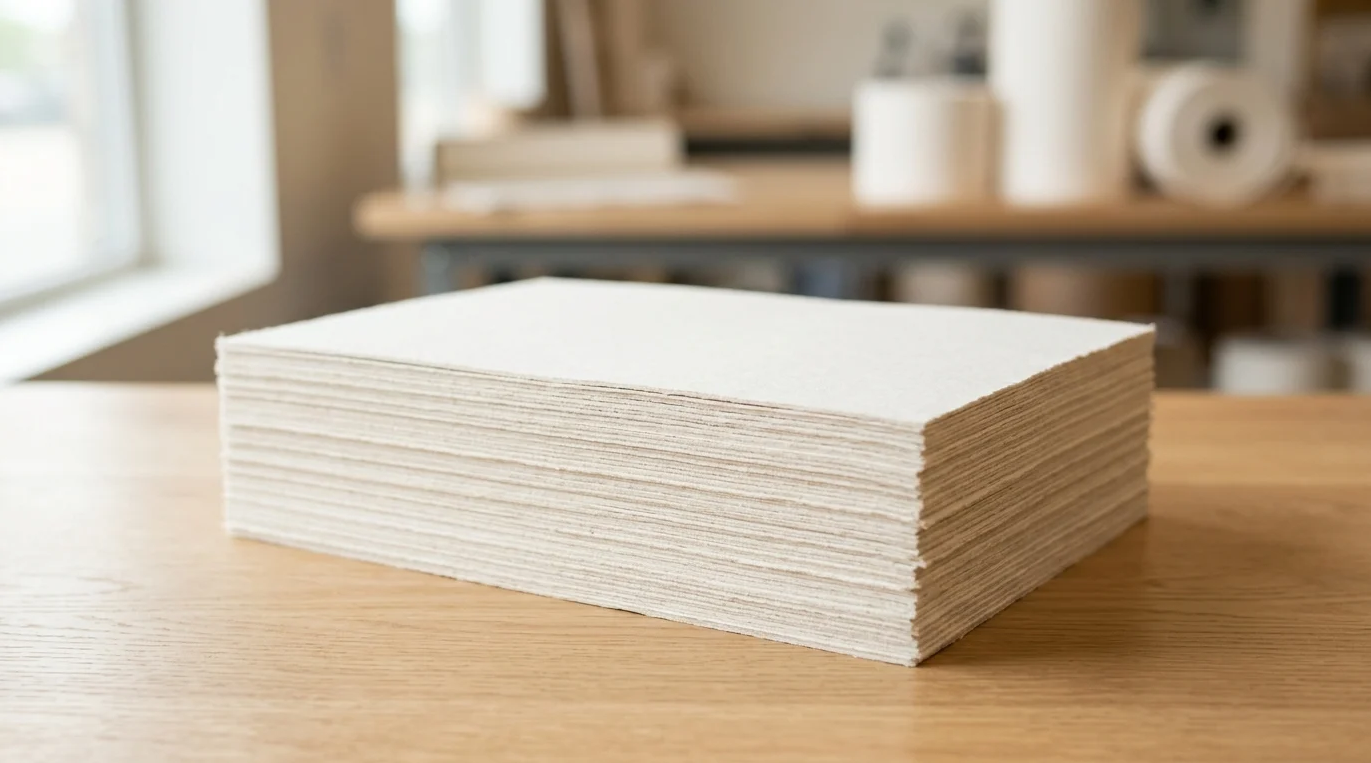
Choosing cupstock is no longer just a matter of ordering a familiar GSM. For converters running modern cup machines at 200 to 300 cups per minute, the wrong board can mean weak rims, poor bottom sealing, excess waste, or cups that collapse under hot liquid. High-bulk cupstock offers a practical route to lower material weight while preserving stiffness, but only when caliper, bulk, internal bond strength, moisture resistance, and forming behavior are evaluated together. This guide explains how to compare specifications, where high-bulk grades create cost and sustainability advantages, and what trade-offs manufacturers should test before moving from standard paperboard to a lighter, higher-bulk substrate.
Why High-Bulk Cupstock Matters
High-bulk cupstock is a specialized paperboard engineered specifically for the production of disposable paper cups, combining exceptional structural performance with food-safe reliability. As the foundation of both hot and cold beverage containers, this material acts as a critical structural and protective barrier. It must withstand thermal stress, resist moisture penetration, and maintain high dimensional stability under pressure.
In commercial applications ranging from 4-ounce espresso cups to 32-ounce cold drink containers, the performance of the base paper dictates both consumer safety and manufacturing efficiency. It is important to distinguish early on that insulated hot cups prioritize thermal resistance and stiffness, whereas single-wall cold cups require stringent moisture barriers and wicking resistance to combat condensation. Transitioning to high-bulk variants allows converters to optimize their material usage without sacrificing the rigidity required for daily operations in quick-service restaurants and institutional catering.
Key Benefits for Paper Cup Manufacturing
The primary advantage of premium cupstock lies in its ability to support high-speed converting machinery while delivering consistent consumer experiences. Modern cup-making equipment operates at speeds of 200 to 300 cups per minute. At these velocities, the optimized fiber formulation of high-bulk board ensures clean, precise creasing and forming, minimizing machine jams and material waste.
Furthermore, the material’s thermal insulation properties are vital for applications requiring hot drink cupstock paper. The base paper must prevent cup collapse during dispensing while keeping exterior handling temperatures comfortable for consumers, routinely managing liquid temperatures up to 95°C without structural failure.
How Bulk Affects Stiffness and Material Use
Bulk is defined as the volume of paper per unit of mass, typically measured in cubic centimeters per gram (cm³/g). While it is a common misconception that stiffness increases exponentially with bulk, the reality is governed by a cubic power-law relationship with caliper: stiffness is proportional to the cube of the board’s thickness. Because the modulus of elasticity may vary with board density, stiffness gains are not automatic. However, when properly engineered, utilizing a high-bulk substrate allows manufacturers to achieve robust sidewall rigidity while reducing the overall basis weight.
By leveraging this relationship, converters can often reduce paperboard weight by 8% to 12% compared to standard grades. This reduction in Grams per Square Meter (GSM) translates directly to lower material costs and reduced shipping weights per thousand cups, yielding significant economic and environmental benefits across large-scale production runs.
However, converters must be aware of the trade-offs inherent to high-bulk boards. Lower density can sometimes result in reduced internal bond strength, lower tensile energy absorption, or decreased edge crack resistance. These factors can directly affect die-cutting, bottom knurling, and rim rolling performance, making material testing essential.
Key Specifications to Compare
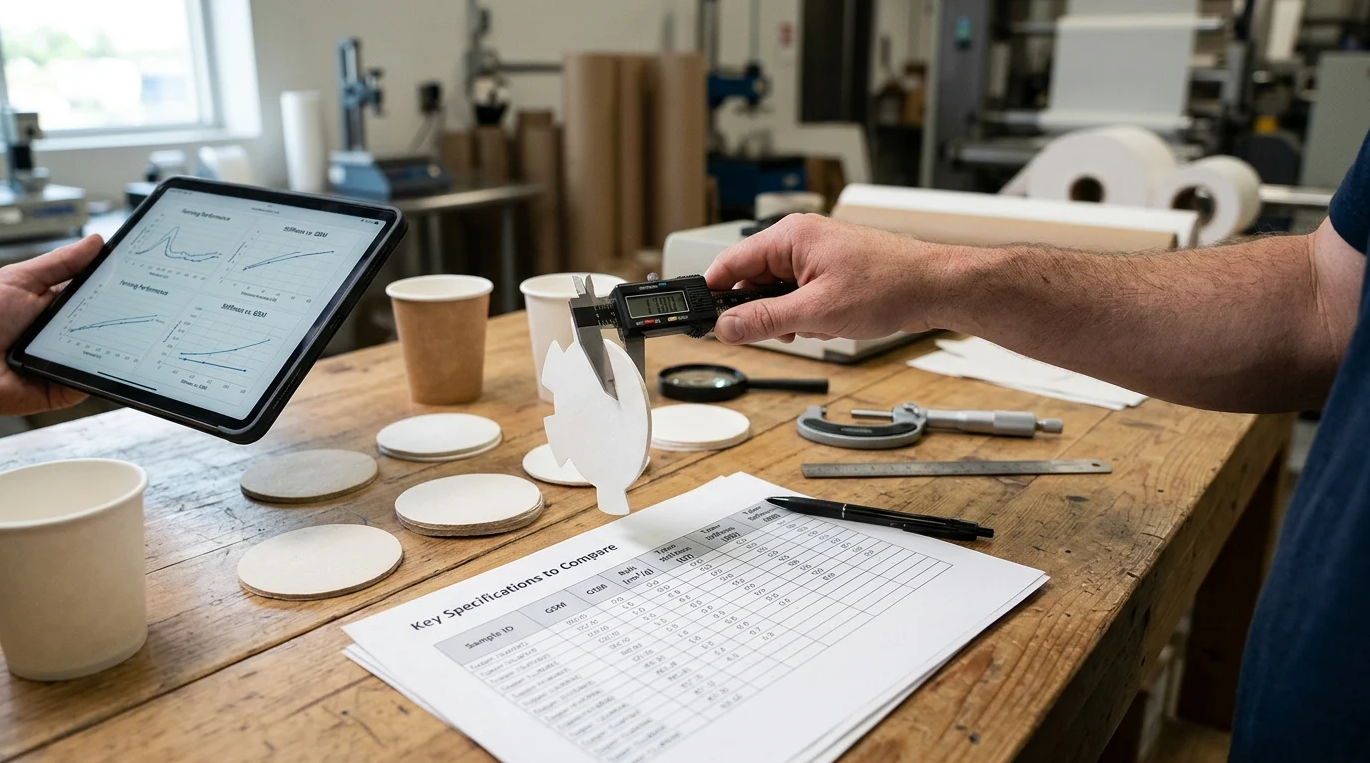
Selecting the appropriate paperboard requires a careful evaluation of technical specifications that govern both the converting process and the final product’s performance. Converters must balance physical dimensions with surface characteristics to ensure seamless manufacturing and high-quality branding.
GSM, Caliper, Bulk, and Stiffness
The relationship between GSM, caliper, bulk, and stiffness forms the core of cupstock evaluation. While standard paperboard typically features a bulk of 1.2 to 1.3 cm³/g, high-bulk variants push this metric higher, allowing for a thicker feel at a lower weight. This is particularly relevant when sourcing a high bulk cupstock paper roll for high-volume production.
It is important to note that the basis weight and caliper ranges in the table below map to specific cup sizes, rim diameters, and sidewall heights; they are not universally interchangeable for any cup format.
| Metric | Standard Cupstock | High-Bulk Cupstock |
|---|---|---|
| Basis Weight (GSM) | 210 – 320 | 190 – 300 |
| Bulk (cm³/g) | 1.15 – 1.30 | 1.40 – 1.65 |
| Caliper (microns) | 250 – 380 | 275 – 450 |
| Bending Stiffness Index | Baseline | +15% to +20% |
Coating, Smoothness, Whiteness, and PE Compatibility
Beyond structural metrics, the surface properties of the paperboard dictate print quality and barrier application. A clay-coated surface provides exceptional smoothness and high ISO brightness (typically ranging from 85% to 90%), enabling vibrant, high-resolution printing for brand differentiation. A uniform, closed surface is critical to reducing ink consumption and achieving crisp graphics.
Additionally, the substrate must exhibit excellent compatibility with barrier coatings. Whether utilizing traditional polyethylene (PE) or sustainable polylactic acid (PLA), the board must accept an even lamination. Depending on the supplier and the specific hot or cold application, this typically involves a barrier layer of roughly 15 to 18 GSM PE to provide liquid resistance. Superior dimensional stability minimizes curl and warpage during this extrusion coating process, ensuring flat sheets or rolls for subsequent die-cutting.
How to Source and Qualify Cupstock
Procuring high-bulk cupstock involves more than comparing specification sheets. Converters must implement rigorous testing protocols and establish a comprehensive supplier qualification framework to ensure consistent runnability and compliance with food safety regulations.
Testing Steps for Converters
Before committing to large-volume orders, packaging converters must validate the material through targeted laboratory and machine tests. Edge wicking resistance is a critical metric, particularly for cold cups prone to condensation. A standard Cobb60 test is utilized to measure water absorption on the uncoated side. While acceptable values are often targeted below 25 g/m², these benchmarks can vary by supplier and specific application requirements.
Runnability trials are equally important to evaluate the aforementioned high-bulk trade-offs. Converters should process sample rolls through their specific cup-forming machines to monitor for edge cracking during bottom knurling and top rim rolling. Evaluating the material’s resistance to thermal shock during the ultrasonic or hot-air sealing phases ensures that the PE or PLA layers bond securely without blistering.
Final Supplier Selection Criteria
Final supplier selection hinges on reliability, scale, and compliance. Rather than dictating rigid mandates, converters should use a qualification framework to evaluate potential partners. For instance, buyers should inquire about typical Minimum Order Quantities (MOQs)—which might range from 15 to 20 metric tons depending on the mill—and verify that standard lead times align with their production schedules.
Quality
Key Takeaways
- Specify high-bulk cupstock by balancing GSM, caliper, bulk, and stiffness rather than selecting paperboard by basis weight alone.
- Use high-bulk substrates to target an 8% to 12% basis-weight reduction while confirming that cup rigidity and forming performance remain acceptable.
- Test internal bond strength, tensile performance, and edge crack resistance before changing to lower-density cupstock grades.
- Match cupstock requirements to end use, because hot cups prioritize thermal resistance and stiffness while cold cups require moisture and wicking resistance.
- Validate cupstock on production equipment running 200 to 300 cups per minute to reduce jams, waste, and sealing defects.
Frequently Asked Questions
What is high-bulk cupstock used for?
High-bulk cupstock is used as the base paperboard for disposable paper cups, including hot drink cups, cold cups, and insulated cup structures. It provides stiffness, dimensional stability, and forming reliability while helping converters reduce basis weight.
How does bulk affect paper cup stiffness?
Bulk increases caliper, and stiffness is strongly influenced by thickness. In practice, stiffness is roughly related to the cube of caliper, but fiber quality, density, and internal bonding also determine whether a high-bulk board performs well.
Can high-bulk cupstock reduce GSM without weakening cups?
Yes, when properly engineered, high-bulk cupstock can often reduce basis weight by about 8% to 12% versus standard grades while maintaining sidewall rigidity. Converters should verify stiffness, forming performance, and edge strength before switching grades.
What specifications should converters compare before buying cupstock?
Key specifications include GSM, caliper, bulk, stiffness, internal bond strength, moisture resistance, surface smoothness, and coating compatibility. These factors affect die-cutting, rim rolling, bottom sealing, print quality, and final cup performance.
Is the same cupstock suitable for hot and cold cups?
Not always. Hot cups need thermal resistance, stiffness, and collapse prevention at high liquid temperatures. Cold cups need strong moisture barriers and wicking resistance to handle condensation and chilled beverages.
Post time: Sep-14-2026