
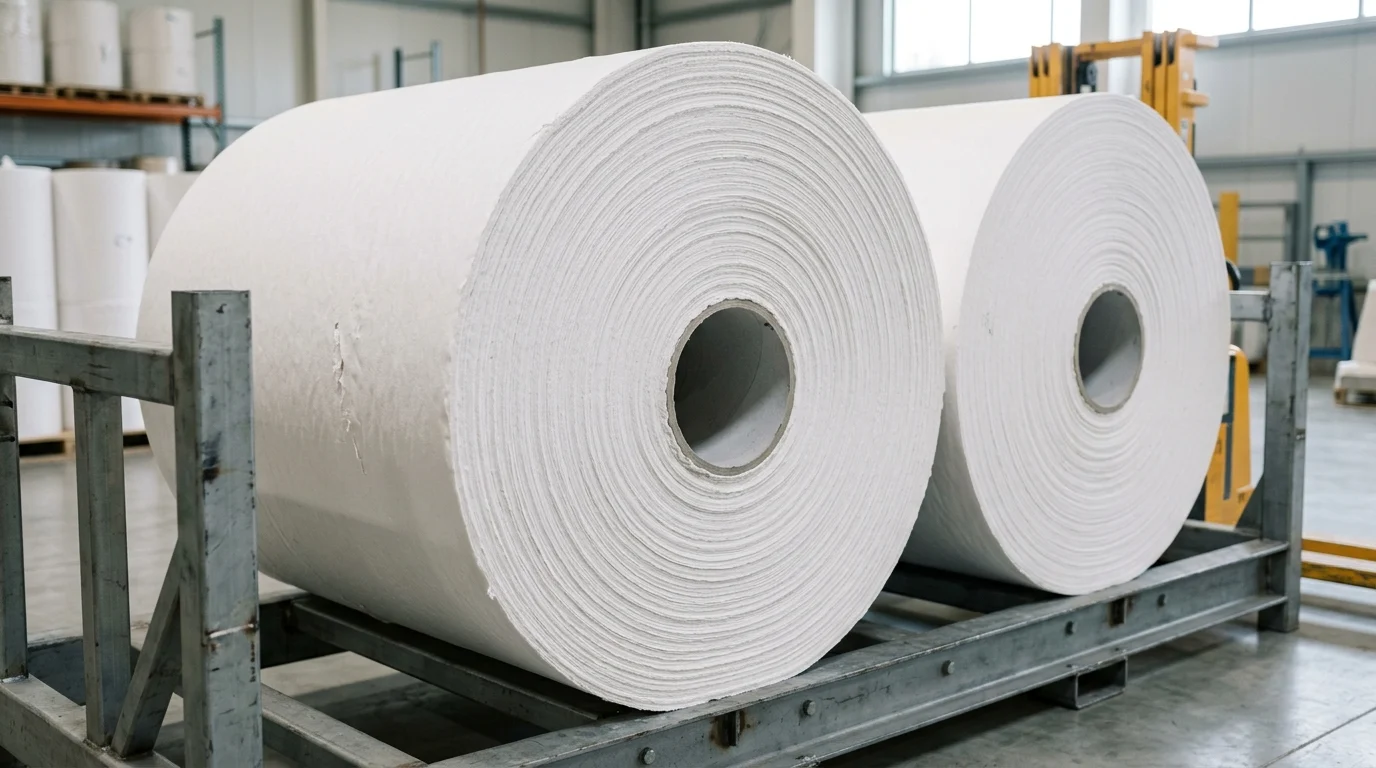
Bleached Tissue Paper Parent Roll Specifications
Bleached tissue paper parent rolls—also interchangeably referred to in the trade as jumbo rolls or mother rolls—serve as the critical raw material foundation for tissue converting facilities globally. When navigating a new converting project, selecting the correct jumbo roll dictates the operational efficiency, product quality, and overall profitability of the manufacturing line.
The distinction between base papers engineered for kitchen rolls versus commercial hand towels is rooted in their distinct physical properties, fiber compositions, and chemical treatments. Understanding these foundational specifications is the first step in optimizing any high-volume paper conversion process.
Definition for Kitchen Towel Converting
In the context of domestic cleaning products, bulk kitchen towel parent rolls are engineered specifically to withstand rigorous liquid exposure and mechanical scrubbing. These parent rolls must possess superior wet strength and high bulk to accommodate deep embossing and glue lamination during the converting process. Without a robust base structure, the paper will disintegrate when exposed to household cleaning solvents or water.
Manufacturers supply these specialized rolls in widths typically ranging from 2700mm to 3600mm, ensuring seamless compatibility with standard high-speed rewinders. The base paper must maintain strict structural integrity when perforated and embossed, requiring a highly uniform fiber distribution across the entire web width to ensure consistent ply bonding.
Fiber Grade, Grammage, Ply, and Absorbency
The performance of bleached tissue paper parent rolls relies heavily on fiber grade and basis weight. While premium kitchen towels predominantly utilize 100% virgin wood pulp to achieve maximum absorbency, superior softness, and a bright, hygienic appearance (often targeting 84-86% ISO brightness, subject to supplier verification), commercial hand towels have different requirements. For instance, hand towel parent rolls often incorporate virgin or recycled blends optimized for high dry-tensile strength and rapid surface wicking rather than deep liquid retention.
Kitchen towel grammage and commercial hand towel specifications differ significantly in structure and composition, as detailed in the comparison table below. Absorbency targets also dictate these differences: kitchen towel base papers are chemically treated to hold substantial water weight (often 5 to 7 times their weight), while hand towel bases prioritize immediate hand drying.
Buyer Comparison Criteria

Procurement teams must evaluate multiple technical and logistical parameters when sourcing bleached tissue paper parent rolls. Establishing clear comparison criteria ensures that the selected base paper aligns with both the mechanical limitations of the converting equipment and the budget constraints of the specific project.
Failing to match the parent roll specifications with the rewinder’s capabilities can lead to high defect rates and accelerated wear on embossing rollers.
Basis Weight, Tensile Strength, and Softness
Basis weight consistency is paramount in high-speed converting, as significant fluctuations can cause uneven tension during the rewinding phase. Tensile strength is rigorously measured in both the machine direction (MD) and cross direction (CD). Optimal parent rolls generally aim for an MD/CD tensile ratio of approximately 2.5:1—providing the necessary pulling strength without sacrificing transverse flexibility—though exact targets vary by machine.
To achieve commercial-grade wet-strength retention, papermakers introduce polyamide-epichlorohydrin (PAE) resins into the pulp matrix during the forming stage. Because these towels are often used in domestic kitchens, buyers must verify that these PAE additives meet relevant environmental and food-contact compliance regulations. Softness, while secondary to strength in commercial hand towels, remains a critical quality metric for premium kitchen rolls to ensure a tactile, cloth-like feel that appeals to retail consumers.
| Specification | Kitchen Towel Parent Roll | Hand Towel Parent Roll |
|---|---|---|
| Typical Grammage | 18–24 gsm (per ply) | 35–45 gsm (single ply) |
| Fiber Composition | 100% Virgin Wood Pulp | Virgin or Recycled Blend |
| Wet Strength Retention* | 20% – 25% | 10% – 15% |
| Absorbency Target | 5–7x paper weight | Rapid surface wicking |
| Typical Roll Diameter | 1100mm – 1500mm | 1100mm – 1500mm |
| Standard Core Size | 76mm (3″) or 152mm (6″) | 76mm (3″) or 152mm (6″) |
| Primary Converting Method | Embossed & Laminated | Folded or Hard-Wound |
*Note: Wet strength retention values depend heavily on the specific test method (e.g., immersion time, rewetting protocol) and are only directly comparable when tested identically across suppliers.
Cost Drivers, Roll Width, Diameter, and Core Specs
Cost drivers for parent rolls are heavily influenced by global pulp indices, energy expenditures, and the specific chemical additives required for wet strength and brightness. Beyond pricing, physical roll dimensions dictate shipping efficiency and line compatibility. As noted in the specifications above, standard roll diameters range from 1100mm to 1500mm, wound on universally accepted 76mm or 152mm internal cardboard cores.
Precise tension control during the initial winding process prevents edge damage and core crushing during transit. Logistically, buyers must optimize freight costs by matching roll widths to standard shipping container dimensions. A well-planned logistics strategy typically allows facilities to load roughly 12 to 15 metric tons of tissue paper into a standard 40-foot high-cube (40HQ) container, maximizing payload and reducing the per-ton landed cost (actual payload varies based on specific roll dimensions).
How Converters Choose the Right Parent Roll
Successfully transitioning from raw material procurement to active production requires a systematic approach to vendor qualification. Converters must validate that the chosen base paper will perform reliably under continuous, high-stress manufacturing conditions.
This validation phase bridges the gap between laboratory specifications and real-world factory floor realities, ensuring the selected rolls yield a profitable finished product.
Sourcing, Sampling, and Runnability Trials
Sourcing begins with evaluating supplier minimum order quantities (MOQs), which generally start at 10 to 15 metric tons for custom parent roll specifications. Before committing to commercial volumes, converters must conduct rigorous runnability trials using sample rolls. These trials assess how the paper behaves at modern line speeds, which can range from 400 to 600 meters per minute depending on the facility’s machinery.
Critical success indicators during this phase include maintaining a web breakage rate of less than 2%, preventing telescoping, ensuring consistent unwind tension, and
Key Takeaways
● Choose kitchen towel jumbo rolls when the finished product needs high wet strength, deep embossing, glue lamination, and absorbency of roughly 5 to 7 times its own weight.
Frequently Asked Questions
What is a bleached tissue paper parent roll?
It is the large base paper roll used by converters to make finished tissue products such as kitchen towels, hand towels, napkins, or toilet tissue. It may also be called a jumbo roll, mother roll, or parent roll.
How do kitchen towel jumbo rolls differ from hand towel parent rolls?
Kitchen towel rolls are designed for high absorbency, wet strength, bulk, embossing, and lamination. Hand towel parent rolls focus more on dry tensile strength, fast surface wicking, dispenser compatibility, and cost-efficient hand drying performance.
What fiber grade is best for premium kitchen towel converting?
Premium kitchen towels commonly use 100% virgin wood pulp because it supports higher absorbency, softness, brightness, and hygienic appearance. Buyers should confirm exact pulp composition and brightness specifications with the supplier before ordering.
Why does wet strength matter for kitchen towel base paper?
Kitchen towels must stay intact when exposed to water, cleaning liquids, and scrubbing. Without adequate wet-strength treatment, the sheet may break during use or fail during embossing, perforating, and rewinding.
What roll width should converters consider?
Kitchen towel parent rolls are often supplied in widths around 2700mm to 3600mm, but the correct width depends on the rewinder, slitting plan, finished roll size, and trim loss target. Always match roll dimensions to your converting line.
Post time: Sep-28-2026