

Why PPWR PFAS Limits Matter for Cupstock Paper
The packaging industry faces a significant transition as the proposed European Packaging and Packaging Waste Regulation (PPWR) targets chemical safety and environmental impact. For brands, coffee chains, and quick-service restaurants relying on paper cups, the evolving rules addressing per- and polyfluoroalkyl substances (PFAS) represent a critical compliance milestone. Historically, manufacturers used these fluorinated compounds as the standard solution for cost-effective grease and water resistance. However, as regulatory negotiations progress, continuing to use PFAS presents substantial market risks.
Suppliers and brands must phase out legacy barrier technologies to avoid potential exclusion across European territories. Furthermore, growing consumer awareness of health impacts prompts food service brands to proactively seek safer alternatives ahead of finalized PPWR enforcement timelines.
What PFAS-Free Cupstock Paper Means
Understanding the specifications of PFAS free cupstock paper—using commercial options like Bincheng Paper as illustrative examples—is a foundational step for procurement teams. Manufacturers engineer this specialized, food-grade paperboard for hot and cold beverage containers, soup bowls, and ice-cream tubs without intentionally adding fluorochemicals. Instead of relying on traditional PFAS treatments, the industry is pivoting to advanced water-based, biobased, or other fluorine-free coating technologies.
These alternative barriers deliver the necessary liquid and grease resistance. Mills typically craft the base material from virgin fiber, controlling the basis weight within the 180 to 320 gsm range. This weight band ensures the board maintains the stiffness, strength, and dimensional stability required for high-speed cup-forming machinery, while offering a smooth surface for food-safe inks and brand embossing.
Why PFAS Limits Affect Food-Contact Packaging
Regulators target PFAS in food-contact packaging due to their environmental persistence and associated health concerns. Under the evolving PPWR framework and broader global chemical restrictions, authorities are drafting stringent thresholds. While lawmakers have not yet finalized the texts, many industry compliance models proactively aim to cap total organic fluorine (TOF) at a provisional 50 mg/kg limit for packaging materials.
Meeting these low thresholds affects the entire production lifecycle, from initial raw fiber sourcing to the final barrier application. If a supplier’s cupstock exceeds these trace limits once regulations take effect, brands risk non-compliance, product recalls, and reputational damage. Sourcing materials that provide adequate liquid barriers while passing rigorous chemical audits now forms the baseline for food service operations.
What Suppliers Should Declare
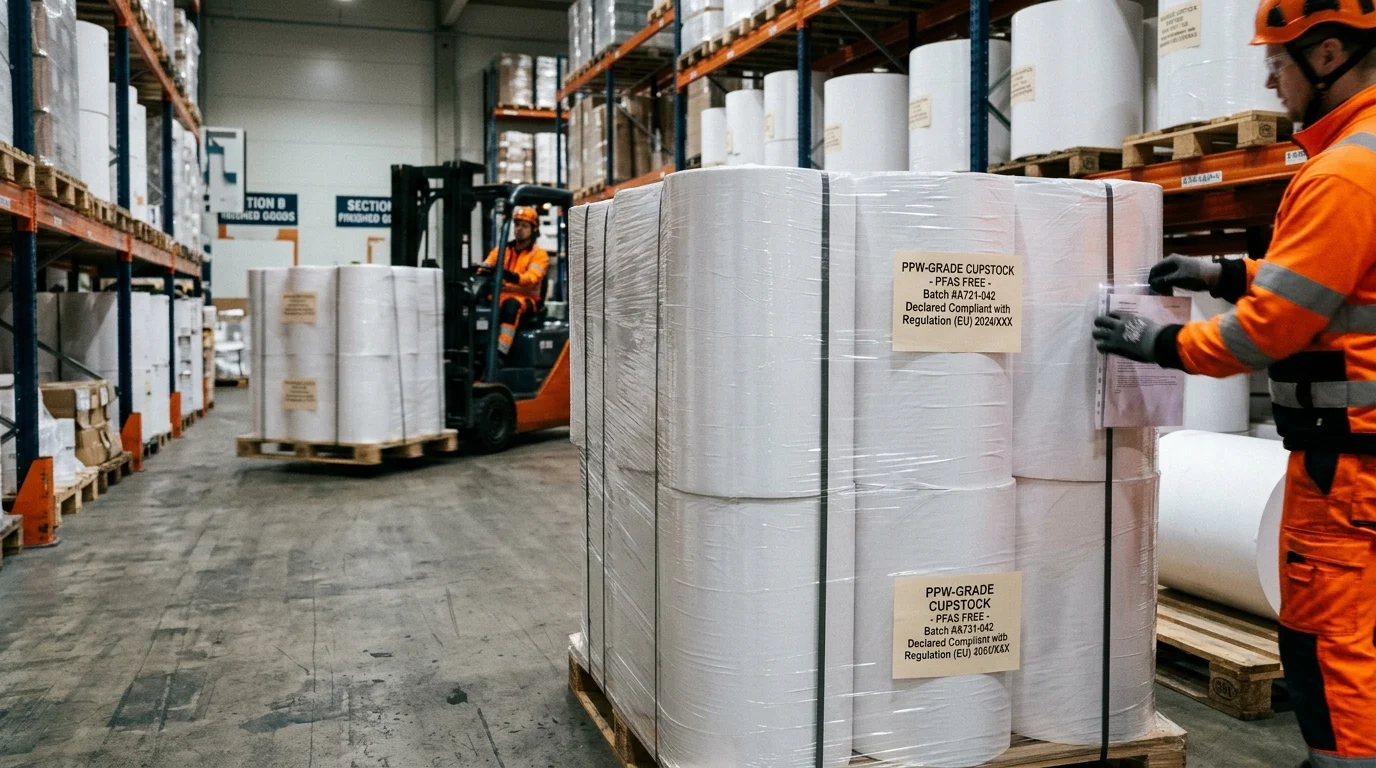
When sourcing compliant paperboard in the current regulatory climate, verbal assurances fall short. The proposed PPWR framework emphasizes clear, documented, and traceable proof that all packaging materials meet evolving chemical safety standards.
Buyers must identify the necessary documentation, understand the technical specifications, and establish accountability with their converting partners to ensure ongoing compliance.
Key PFAS Declaration Points
A comprehensive Declaration of Compliance (DoC) must explicitly state that the manufacturer intentionally added no PFAS during production. However, because accidental cross-contamination can occur in recycled water streams or on shared machinery, recent third-party lab testing results for total organic fluorine should support the declaration.
Procurement teams must examine these test results; as an illustrative benchmark, industry best practices often recommend seeking a limit of detection (LOD) around 10 parts per million (ppm) or lower to ensure adequate safety margins. The documentation must also verify that the alternative barrier coatings fully comply with relevant food-contact regulations, ensuring they do not introduce new chemical migration risks when exposed to acidic or high-temperature liquids.
Buyer Comparison Criteria
Comparing potential suppliers requires looking beyond the simple absence of fluorinated compounds. Procurement teams must balance chemical compliance with functional performance, technical limitations, and overall cost efficiency.
| Feature | Legacy Fluorochemical Cupstock | PFAS-Free Alternative Cupstock |
|---|---|---|
| Barrier Chemistry | Fluorochemical treatments | Water-based / Biobased coatings |
| Total Organic Fluorine | Historically > 100 mg/kg | < 50 mg/kg (Provisional target) |
| Hot-Fill Compatibility | Broadly compatible | Varies; requires specific formulation |
| Maximum Liquid Hold Time | Extended duration | Often shorter; requires rigorous testing |
| Repulpability | Varies by coating type | Often compatible with standard streams* |
| Estimated Cost Premium | Baseline | Illustrative 10% to 15% range |
*Note: Actual repulpability and compostability depend heavily on local commercial infrastructure.
While some newer PFAS-free options may currently carry an illustrative initial cost premium of 10% to 15%, this gap should stabilize as global manufacturing scales up. Furthermore, these materials can offset their upfront expense by offering improved end-of-life processing. Features like enhanced repulpability align with broader PPWR sustainability goals, which may ultimately help brands manage extended producer responsibility (EPR) fees and regional waste management taxes.
How Buyers Can Verify and Source PFAS-Free Cupstock
Transitioning a product line to compliant packaging materials requires strategic planning. Buyers need a systematic approach to verify supplier claims, test new materials, and integrate these modern substrates into existing supply chains.
Collaboration between procurement professionals, quality assurance teams, and packaging engineers remains essential to ensure the shift does not disrupt standard production schedules.
Procurement Verification Steps
The first step in verification involves auditing the supplier’s testing protocols. Beyond a standard safety data sheet, buyers should request comprehensive, batch-specific migration test reports from internationally accredited laboratories. Procurement teams should also run smaller trial orders before committing to a long-term contract.
Because specialized bio-coatings involve complex manufacturing, paper mills and suppliers often require minimum order quantities (MOQs)—illustratively ranging between 5 to 10 metric tons for custom production runs. Running a pilot batch allows converters and packaging engineers to test how the board behaves on the production line, ensuring the new coatings do not cause machine sticking or structural failures during the cup-forming process.
Specification and Compliance Guidance
Updating internal material specifications to explicitly require these compliance documents is crucial for long-term regulatory alignment. Procurement teams must establish clear guidelines that mandate regular re-testing and updated Declarations of Compliance (DoC) from all cupstock suppliers.
To prepare for impending enforcement, companies must map out a transition timeline that accounts for regulatory uncertainties.
Key Takeaways
● Ask every cupstock supplier for a written declaration confirming that no PFAS were intentionally added during production.
Frequently Asked Questions
What does PFAS-free cupstock paper mean?
It means the cupstock is produced without intentionally added fluorochemicals, using alternative barrier technologies such as water-based or biobased coatings to provide liquid and grease resistance for paper cups and foodservice containers.
Why do PPWR PFAS limits matter for paper cup suppliers?
The proposed PPWR is expected to tighten chemical safety requirements for packaging sold in Europe. Suppliers that cannot document low PFAS or total organic fluorine levels may expose buyers to compliance risks, recalls, or market access issues.
What should a supplier declare about PFAS?
A supplier should declare that no PFAS were intentionally added during production and support the claim with recent third-party lab testing, ideally including total organic fluorine results and relevant food-contact compliance documentation.
What TOF level is often used as a benchmark?
Although final PPWR thresholds may still evolve, many compliance models use 50 mg/kg total organic fluorine as a cautious provisional benchmark for food-contact packaging materials.
What cupstock basis weights are commonly used?
PFAS-free cupstock is commonly produced in the 180 to 320 gsm range, giving converters the stiffness, strength, and dimensional stability needed for high-speed cup forming.
Post time: Nov-09-2026