
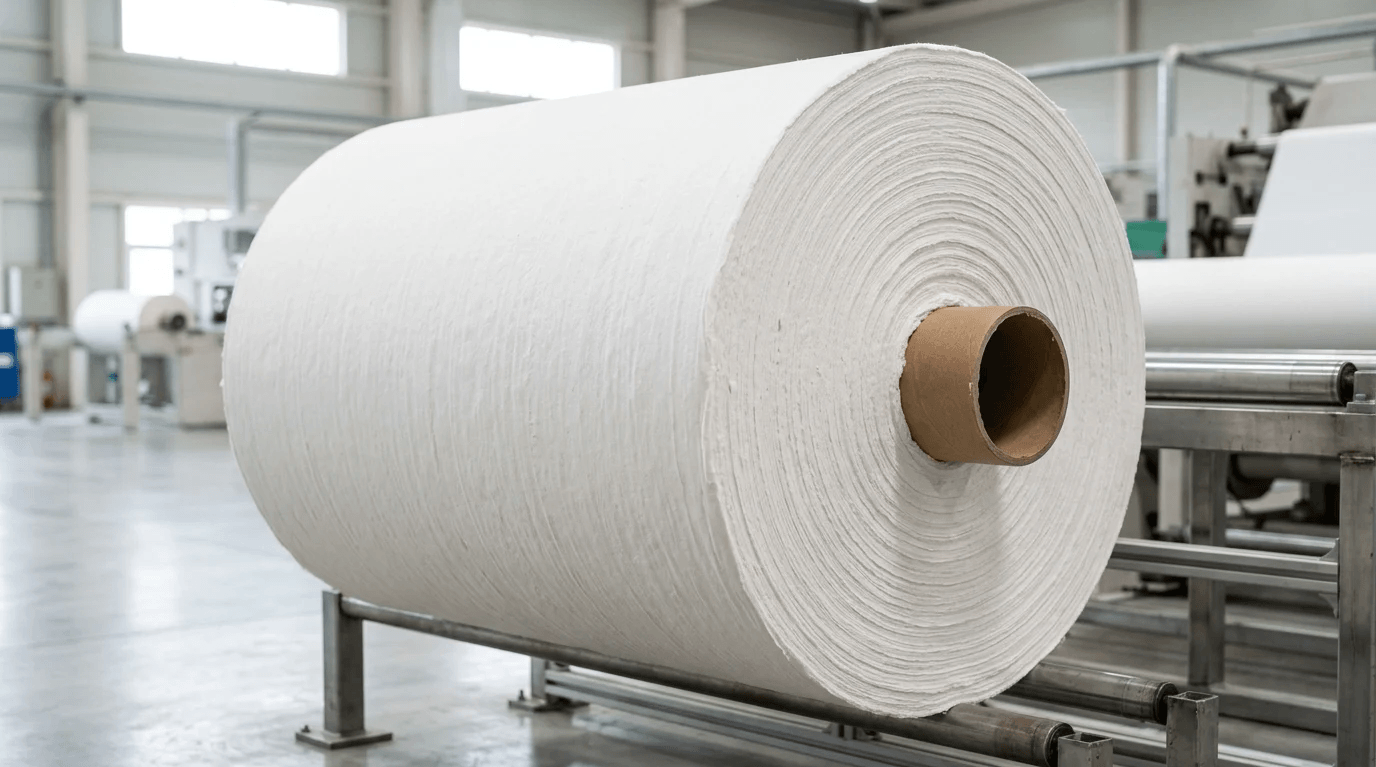
A tissue product’s softness, absorbency, and converting performance are largely decided before it ever reaches the rewinder. For buyers, the real question is not just whether a roll is made from virgin wood pulp, but whether the supplier’s reports prove it can run efficiently and meet the target market standard. Fiber composition, GSM, brightness, moisture, roll dimensions, absorbency, and strength data all influence yield, downtime, and finished product consistency. This guide explains what procurement and technical teams should verify in a tissue parent roll specification sheet, how to interpret key numbers such as 12–42 GSM and 4%–7% moisture, and which physical defects can disrupt converting.
Key Specifications to Confirm
When sourcing a virgin wood pulp tissue parent roll, verifying baseline specifications is essential to ensure seamless converting operations. These jumbo rolls serve as the foundation for tissue production. Whether a facility manufactures luxury facial tissues or industrial wiping products, the input substrate dictates final quality. Procurement teams must verify specific metrics in supplier reports before issuing a purchase order.
Fiber Content, Brightness, and GSM
The first metric to verify on any supplier report is the composition. Standard premium tissue requires a carefully balanced blend of hardwood and softwood virgin fibers. The optimal ratio varies by end-use: softwood pulp provides the essential tensile strength needed for machine runnability and heavy-duty hand towels, while hardwood pulp contributes to the softness and bulk ideal for facial tissue. Alongside fiber composition, buyers must evaluate the basis weight, which typically ranges from 12 to 42 GSM depending on whether the application is a delicate facial tissue or a heavy-duty wipe.
Brightness is another critical factor for consumer appeal in luxury and hospitality markets. Lab reports for bleached virgin grades should confirm an ISO brightness level between 86% and 90%. Conversely, unbleached virgin pulp is often used in specific industrial and food-service applications, which have substantially different optical requirements. If a facility is sourcing custom parent rolls, ensuring these optical metrics are accurate will maintain the desired appearance in the finished goods.
Procurement teams must also verify the delivered moisture content. As a critical substrate attribute, a premium parent roll should maintain a 4% to 7% moisture range. Moisture levels above 7% can cause degradation during transit, while levels below 4% render the paper brittle, increasing the risk of web breaks during slitting or embossing.
Roll Width, Diameter, and Core Size
Physical dimensions dictate machine compatibility on the factory floor and influence shipping logistics. Parent rolls can be manufactured with extreme dimensions—such as widths up to 5,520 mm—but these represent maximum machine capabilities rather than standard stock sizes. Buyers typically need to specify exact slit-width requirements tailored to their specific unwinders. Diameters range from 1,000 to 2,560 mm; while a 1,150 mm diameter is frequently selected to optimize space inside standard ocean shipping containers, the optimal size must ultimately match the buyer’s equipment constraints.
Core size is equally critical. While a 76 mm (3-inch) core is common, it is not universal; many parent rolls utilize 150 mm or larger cores. Verifying the core dimensions ensures compatibility with the facility’s unwind chucks and maintains stable tension control during processing. Transit protection, meanwhile, depends on proper wrapping and handling protocols rather than the core size itself.
Beyond basic dimensions, buyers must inspect for critical parent-roll defects. Standard checklist items include reel-edge condition, machine direction (MD) caliper uniformity, and the absence of wrinkles or holes. Core crush must also be strictly avoided, as a damaged core prevents proper chucking. These physical criteria are primary determinants of unwinding success.
Performance and Quality Comparison
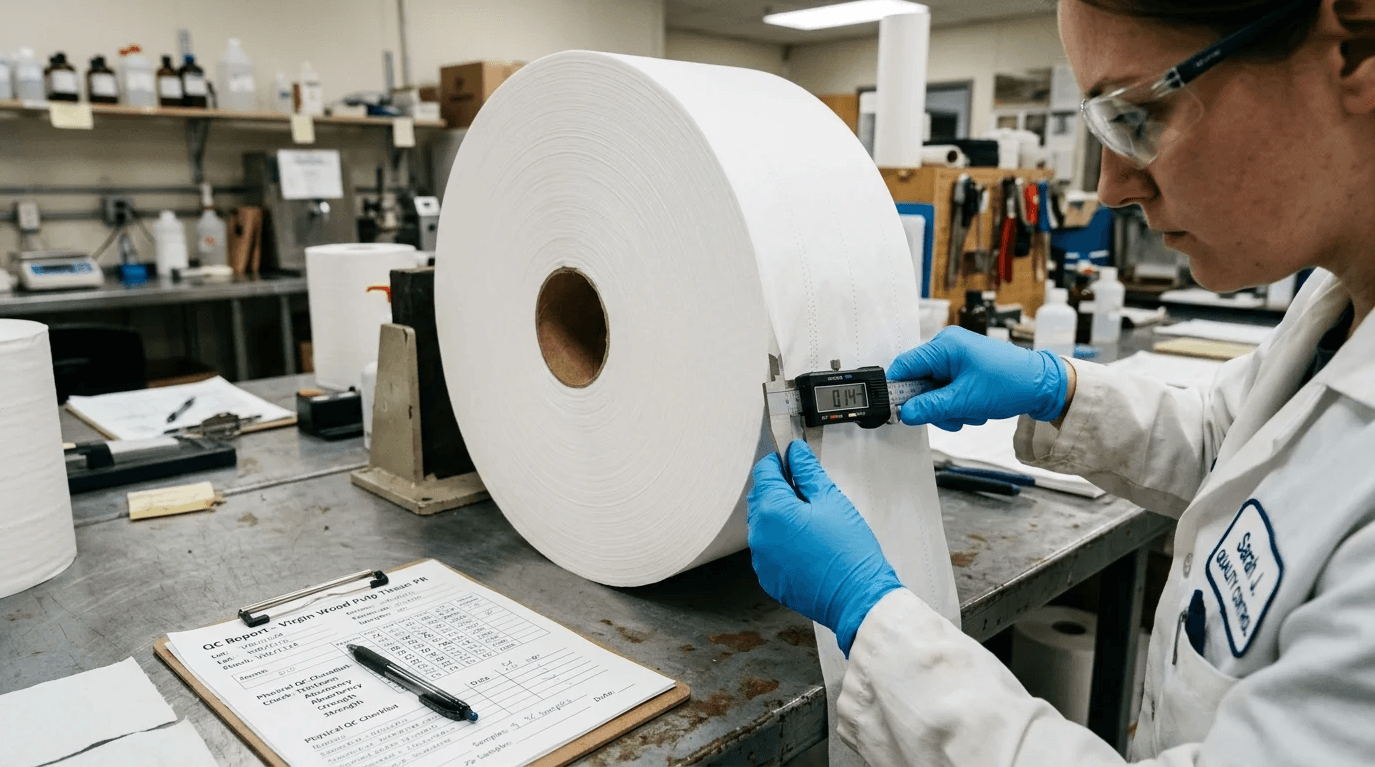
Beyond dimensional specifications, buyers must evaluate how the parent roll performs on high-speed converting lines. The parent roll acts as a semi-finished substrate that must endure rigorous slitting, embossing, laminating, and perforating. Understanding the mechanical performance of virgin fiber helps justify its selection over alternative materials and ensures reliable processing under mechanical tension.
Fiber Purity, Absorbency, and Strength
Virgin wood pulp provides superior mechanical performance, which should be verified using standardized testing such as the ISO 12625 series. Rather than citing the standard broadly, converters should look for specific metrics: ISO 12625-4 for Machine Direction (MD) and Cross Direction (CD) tensile strength, ISO 12625-8 for water-absorption time and capacity, and ISO 12625-3 for thickness, bulk, and specific volume. Softness should be evaluated separately using dedicated test methods like the EMTEC Tissue Softness Analyzer (TSA) or a Handle-O-Meter. These factors are critical when converting hand towel parent rolls, where rapid absorbency and physical durability are primary requirements.
Furthermore, converters must evaluate lint and dust generation alongside cross-directional (CD) basis-weight profile uniformity. Low dust levels are critical for maintaining clean converting environments and high final-product quality, while a uniform CD basis-weight profile ensures consistent winding and prevents telescoping on the machine.
Trade-Offs Between Virgin and Alternative Grades
While purchasing departments may evaluate recycled grades to reduce costs, the production trade-offs are significant. Virgin wood pulp features a highly uniform fiber structure that translates to excellent machine runnability, resulting in fewer web breaks and reduced downtime. However, virgin pulp typically carries a significant price premium, meaning the runnability and waste arguments only hold when the end-product positioning and continuous throughput justify the higher input cost.
| Feature | Virgin Wood Pulp | Recycled Pulp |
|---|---|---|
| Illustrative Converting Loss* | ~1% – 3% | ~3% – 7% |
| ISO Brightness | 86% – 90% (Bleached) | Typically < 80% |
| Moisture Content | 4% – 7% | Highly Variable |
| Best Application | Premium, Food-Safe, Medical | Economy, Industrial |
*Note: Converting losses are illustrative ranges; actual waste varies widely based on machine condition, tension control, and specific paper grades.
Because the virgin pulp price premium fluctuates with market conditions, buyers should calculate break-even volumes rather than assuming virgin fiber always delivers a lower total cost of ownership (TCO). A robust TCO model should factor in the reduced machinery downtime and lower waste percentages of virgin rolls against current market pulp indices to determine true cost-efficiency.
Buyer Verification and Decision Steps
Establishing baseline specifications and performance metrics is only the first phase of procurement. Buyers must practically vet suppliers to ensure they deliver on the parameters detailed in their lab reports. Implementing a standardized verification routine protects the supply chain from costly defects.
Sample Review and Supplier Documentation
Before committing to a commercial volume order, buyers should request a sample roll to conduct a trial on their own converting equipment.
Key Takeaways
- Confirm the hardwood and softwood virgin fiber ratio because softwood improves tensile strength while hardwood supports softness and bulk.
- Match the 12 to 42 GSM basis weight range to the intended product, from lightweight facial tissue to heavier hand towels or wipes.
- Require moisture content between 4% and 7% to reduce transit degradation, brittleness, and web breaks during converting.
- Verify ISO brightness of 86% to 90% for bleached virgin grades used in premium, hospitality, and consumer-facing tissue products.
- Check roll width, diameter, and core size against your unwind equipment, since parent rolls may range from 1,000 to 2,560 mm in diameter.
- Inspect reel edges, wrinkles, holes, caliper consistency, and core crush before acceptance to protect runnability and finished product quality.
Frequently Asked Questions
What fiber details should buyers request before ordering tissue parent rolls?
Buyers should request the virgin fiber composition, including hardwood and softwood ratio. Softwood supports tensile strength and runnability, while hardwood improves softness and bulk for facial tissue or premium products.
What GSM range is typical for virgin wood pulp tissue parent rolls?
Typical basis weight ranges from 12 to 42 GSM, depending on the end product. Lower GSM suits soft facial or toilet tissue, while higher GSM is more appropriate for hand towels and wiping products.
Why is moisture content important in a parent roll report?
Moisture should generally stay between 4% and 7%. Above 7%, rolls may degrade during transit; below 4%, the sheet can become brittle and cause web breaks during slitting, embossing, or rewinding.
What brightness level should bleached virgin tissue rolls meet?
For bleached virgin tissue grades, buyers should typically confirm ISO brightness of about 86% to 90%. This is especially important for retail, hospitality, facial tissue, and premium hygiene products.
Which roll dimensions must be checked for converting compatibility?
Buyers should confirm roll width, diameter, and core size against their unwinders. Common diameters range from 1,000 to 2,560 mm, while cores may be 76 mm, 150 mm, or larger depending on equipment.
Post time: Sep-13-2026