
Why Kraft Paper Roll Width Matters in Converting
When setting up a converting line, getting the dimensions right is critical. Kraft paper rolls feed high-speed machinery, and the chosen width directly impacts everything from production speed to material waste. Hard machine constraints—such as maximum unwind stand width, slitter capacity, and maximum outer diameter—often dictate feasible roll dimensions more directly than material specifications alone.
With modern converting equipment running anywhere from 150 to 300 meters per minute, even a slight mismatch in roll dimensions can cause significant downtime. Understanding how width interacts with the rest of the paper’s specifications and the physical limits of the machinery is essential for keeping operations smooth and cost-effective.
What Roll Width Includes Beyond the Stated Measurement
While the width on the spec sheet is important, a roll’s physical footprint involves several other factors. Buyers must account for edge tolerance, which typically ranges from +/- 2mm to 5mm depending on the mill’s slitting precision.
Additionally, the core dimensions—usually standard 3-inch or 6-inch inner diameters—determine how the roll mounts onto the unwind stand. When a roll is loaded, the outer diameter and the exact edge profile dictate how well the web tracks through the machine without wandering off alignment or exceeding the physical clearances of the equipment.
How Grammage, Roll Length, Winding Stability, and Tensile Strength Affect Performance
Width does not operate in a vacuum; it interacts heavily with other physical properties. For instance, a wide web of lightweight 50 GSM paper will behave very differently under tension than a heavy 120 GSM board.
Roll length is equally critical. For a given width and grammage, a longer roll increases the total outer diameter. If the roll length pushes the outer diameter beyond the unwind stand’s maximum capacity, the roll cannot be mounted, regardless of whether the width is a perfect fit.
Winding stability is also crucial. If a wide roll is wound too loosely, it suffers from telescoping, where the edges push outward during transit or unwinding, causing web breaks. Furthermore, the paper’s tensile strength, especially the ratio between the machine direction (MD) and cross direction (CD), determines how much tension the wide web can handle before snapping or wrinkling across its span.
How to Compare Kraft Paper Roll Width Options Before Buying
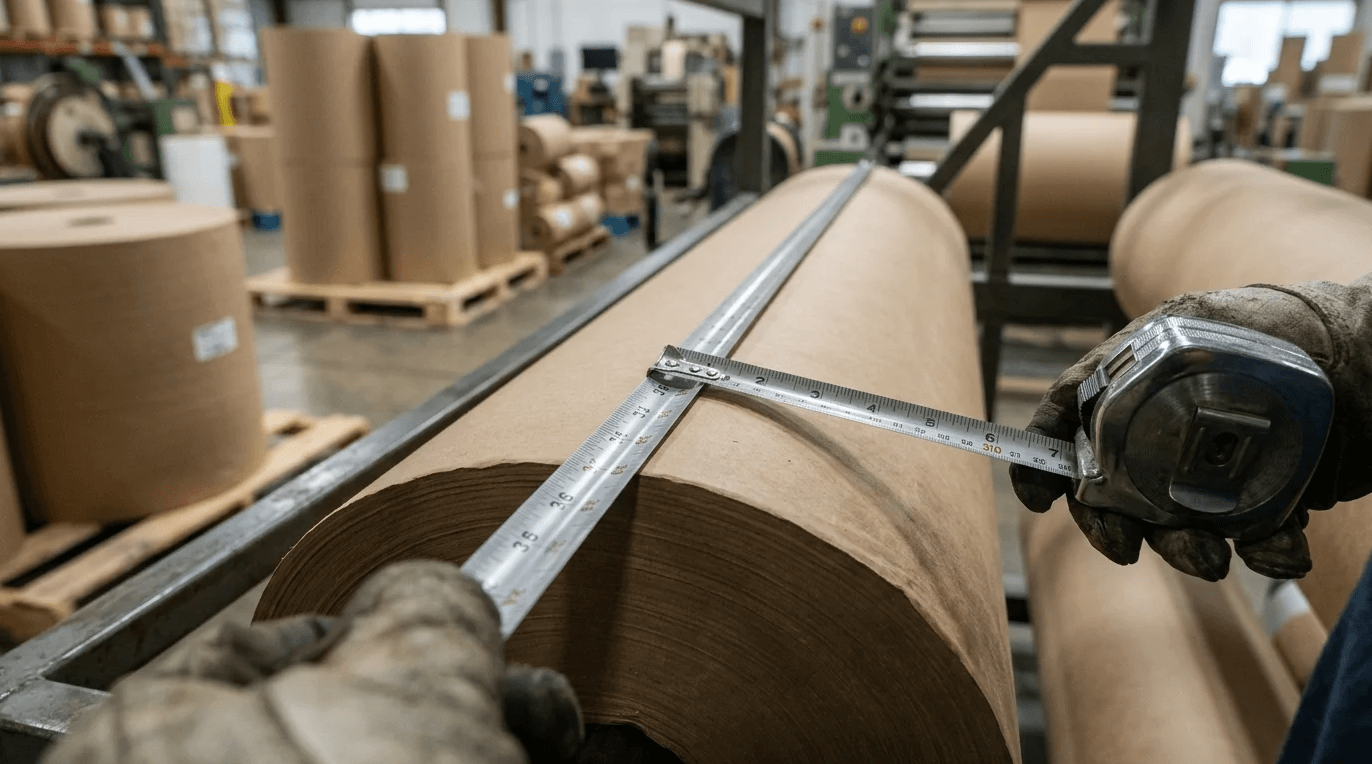
Sourcing the right materials means looking closely at what suppliers actually offer versus what the machinery demands. Comparing options requires balancing upfront costs with long-term production efficiencies.
Standard widths are readily available and easier to source quickly, but custom sizes might require higher minimum order quantities (MOQs), making volume a major deciding factor in the procurement process. Furthermore, global procurement teams must note regional differences in standard widths—such as metric versus imperial conventions—to ensure a “standard” width is actually available within their specific supply chain.
It is also important to note that custom widths are fundamentally limited by upstream paper machine deckle width and slitter rewinder constraints. A mill can only slit parent rolls into combinations that minimize their own trim waste, meaning custom sizes are dictated by parent roll dimensions, not solely by MOQs or slitting fees.
Key Comparison Points for Specifications and Supplier Quotes
When requesting quotes and evaluating suppliers, buyers should look at a few specific variables beyond just the price per ton. Shipping configurations and slitting fees all play a role in the final cost. Standardizing on common widths can often bypass custom slitting upcharges.
As shown in the table below, custom widths typically require higher minimums and longer waits, so procurement strategies must balance these logistical constraints against the material savings of a perfect machine fit.
Note: The figures in the table below are general estimates; exact MOQs, lead times, and slitting fees will vary significantly by supplier, region, and order volume.
| Specification | Standard Widths (e.g., 900mm, 1200mm) | Custom Widths |
|---|---|---|
| Typical MOQ | 1 to 2 Metric Tons | 3 to 5 Metric Tons |
| Lead Time | 1 to 2 Weeks | 4 to 6 Weeks |
| Cost Premium | Base Market Price | +5% to +15% Slitting Fee |
| Trim Waste | Higher (if not a perfect machine fit) | Optimized lateral edge trim (setup/core waste remains) |
Using a comparison matrix like the one above helps procurement teams quickly identify whether the savings on lateral edge trim waste outweigh the premiums attached to custom slitting.
How Virgin, Recycled, Coated, Waxed, and Food-Grade Papers Differ
Beyond dimensions, the paper’s composition changes how it runs on the line, directly influencing width selection. Virgin kraft paper offers the highest tear resistance and stiffness, making it capable of supporting wider webs without snapping under high machine tension.
Recycled kraft, while more eco-friendly and cost-effective, sometimes has slightly lower tensile strength. This requires careful tension control on wider rolls—or a deliberate shift to narrower widths—to prevent tearing. Coated and waxed variants introduce moisture and grease barriers but add thickness and weight. This added bulk means a roll of a specific width and length will have a larger outer diameter than uncoated paper, potentially exceeding the limits of the unwind stand. Finally, while food-grade papers must meet strict contact regulations, these certifications do not physically alter the web’s tensile properties or thickness, meaning they have no direct impact on roll width selection or machine tension limits.
Practical Steps to Choose the Right Kraft Paper Roll Width
Moving from theory to the factory floor requires precise calculations and a clear understanding of the end product. The goal is to maximize the amount of usable material while keeping the converting machines running smoothly.
A well-optimized line should aim to keep lateral edge trim waste below 3% to 5% of the total roll width, ensuring that material costs do not eat into the profit margins of the finished goods. It is important to distinguish this lateral trim from total process waste, as setup waste, core waste, and occasional edge damage will still occur regardless of width optimization.
Key Takeaways
- Confirm the converting line’s maximum unwind width, slitter capacity, core size, and outer diameter limit before selecting a kraft paper roll.
- Allow for normal slitting tolerance of about +/-2 mm to 5 mm when specifying kraft paper roll width.
- Check grammage, roll length, and outer diameter together because a roll with the right width can still be too large to mount.
- Choose standard widths for faster sourcing, but evaluate custom widths when trim waste reduction offsets higher MOQs.
- Assess winding stability and MD/CD tensile strength before running wide kraft paper rolls at 150 to 300 meters per minute.
Frequently Asked Questions
Why does kraft paper roll width matter on a converting line?
Roll width affects machine fit, web tracking, production speed, and waste. A mismatch with the unwind stand, slitter, or clearance limits can cause downtime even if the paper grade is correct.
What tolerance should buyers expect on kraft paper roll width?
Typical edge tolerance is about +/-2 mm to 5 mm, depending on the mill’s slitting precision. Always confirm tolerance before ordering, especially for high-speed or narrow-margin converting work.
How do roll width and outer diameter interact?
For the same grammage, a wider or longer roll can increase total roll size and handling load. If the outer diameter exceeds the unwind stand’s limit, the roll cannot be used safely.
Is a standard kraft paper roll width always the best choice?
Standard widths are usually faster to source and may reduce cost, but they are not always the most efficient. Custom widths can reduce trim waste if order volume justifies the MOQ.
What core size is common for kraft paper rolls?
Common core inner diameters are 3 inches and 6 inches. The correct core size must match the converting line’s shaft or chuck system to ensure stable mounting and unwinding.
Post time: Oct-27-2026